

Katie Wilson wants to transform Seattle; she will need a public bank to do so.
With a narrow victory of less than 1%, progressive political outsider Katie Wilson will become Seattle’s next mayor. Undoubtedly, she will be one of the city’s farthest leftwing mayors, at least in contemporary history. Like her counterpart in New York City, mayor-elect Zohran Mamdani, Wilson describes herself as a democratic socialist and defeated her establishment opponent by emphasizing the need to address Seattle’s affordability crisis, especially the city’s crushing housing cost.
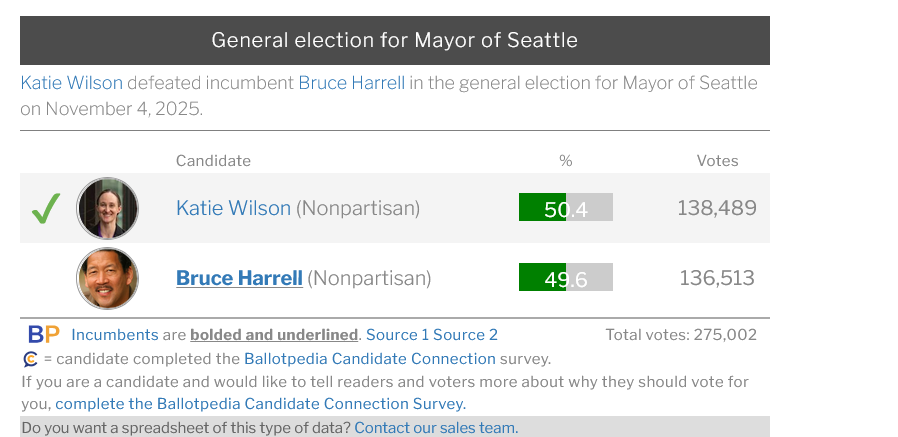
The question now is how will she do it?
In many ways, her ability to wrestle the city’s economy to the ground and force it to work for Seattle’s working class is far more limited than her predecessor. Yes, Bruce Harrell did have to manage the city’s post-pandemic economy, including relentless inflation, but he could fall back on the fact that Seattle was America’s leading city in economic growth, increasing by a vigorous 6.2% from 2022 to 2023.
Wilson, on the other hand, will likely take office amidst a significant slowdown, potentially even a recession. One third of the city’s GDP is made up of the tech industry, and that sector has seen massive layoffs recently. Additionally, she will have to navigate the utterly cruel cuts made to Medicaid, the Supplemental Nutrition Assistant Program (SNAP), and student loans in President Trump’s deranged One Big Beautiful Bill Act. All of this will be on top of the fact the city expects a $140 million deficit in 2027.
To keep programs funded, Wilson has vowed to pursue progressive revenue sources. Here, she has the expertise to push meaningful reforms. Wilson served on the Seattle Revenue Stabilization Workgroup in 2023, and—unlike Harrell—has promised to actually implement some of its suggestions rather than filing them away in a bureaucratic black hole.
Still, even with exceptional persistence and creativity, revenue options are limited. With the passage of HB 2049, Seattle does have a higher cap on raising property taxes, but property tax increases can be politically perilous. Meanwhile, a graduated income tax is still not possible without a constitutional amendment or convincing the Washington Supreme Court to overturn Culliton v. Chase (1933); those are two things that are unlikely to happen soon.
These challenges of course do not mean that Wilson should give up. Rather, it means the fight for economic justice in Seattle needs to move beyond progressive revenue and into a fight over progressive credit, namely through chartering a city owned and operated public bank.
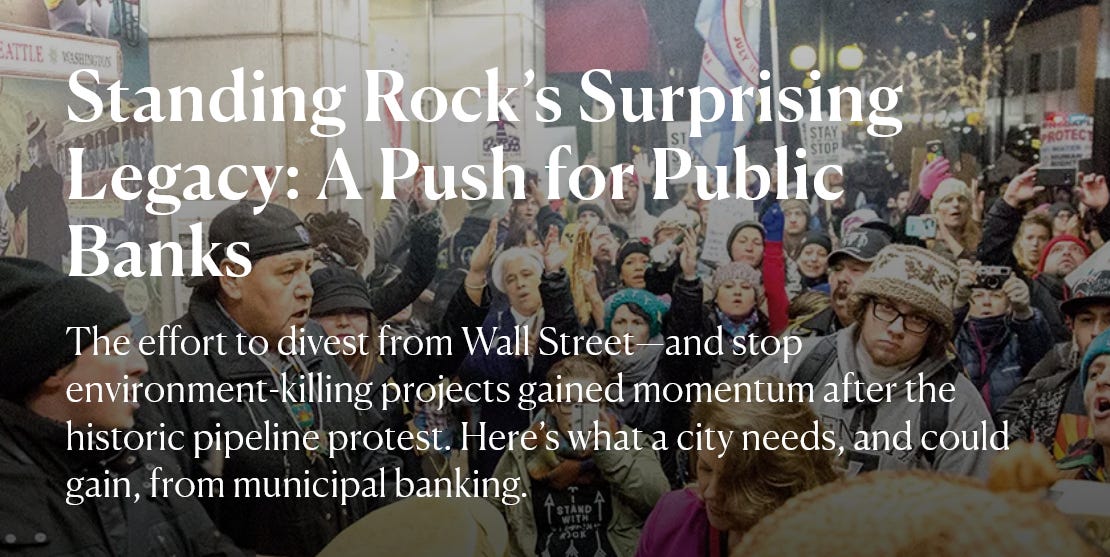
Seattle has examined the possibility of public banking before. During the height of the protest against the Dakota Access Pipeline, the city considered pulling its deposit out of Wells Fargo—a major financier of the project—and moving it to a public institution. In 2018, the city commissioned a feasibility study on public banking. Despite affirming the concept of public banking, the study emphasized numerous regulatory and financial challenges, but often these challenges were based on erroneous assumptions.
First, the study noted the constitutional obstacles to creating a public bank, especially the “prohibition on gifts of public funds” as defined in Article VIII, Section 7, which prevents governments from lending credit or funds to private entities except under narrow circumstances. It also recommended amending the Seattle charter to explicitly allow the city to engage in banking activities. However, all this handwringing over these supposed legal barriers is unnecessary. The city can bypass the constitutional restrictions or any hurdles within its own charter by establishing a public bank as a public development authority (PDA). PDAs are the most common ways cities in Washington engage in economic development, and already many of them have lending programs to private businesses. Since PDAs have a separate governing structure and are denied the power to tax or exercise eminent domain, they operate outside of Article VIII, Section 7, and with multiple Seattle PDAs already in existence no changes to the city charter are needed to make more.
Second, the study noted the city would have to raise capital—both to protect deposits against potential losses and for operations and maintenance—for the public bank, which would be a sizable sum that the city would need to extract from the general fund or another revenue source. While this is true, pulling from current sources or a new tax are not the only ways the bank could become capitalized. Instead, the bank could become self-capitalized by initially operating as a revolving loan fund for housing projects. Instead of putting money toward capitalization, and have it sit there while the regulatory process plays itself out, funds that Washington or Seattle would want to utilize for housing could be transferred to an intermediate revolving loan fund that would eventually operate as a public bank. Once those loans are on its books, the soon-to-be public bank could then sell them on the secondary market to other institutions that will package them as mortgage-backed securities, thus raising its own capital. Additionally, by primarily acting as a lender for housing provided by public institutions the bank can collateralize its deposits to the satisfaction of the state’s Public Deposit Protection Commission. Gradually, as its capital grows, it can eventually diversify its assets and start lending to projects other than publicly owned housing.
Even as a more limited transitional institution that is primarily focused on lending to publicly owned housing projects, the bank would still be of tremendous use to Seattle. One of Wilson’s campaign promises is to pursue a $1 billion bond for “union-built affordable housing.” Instead of issuing a bond of that size, which would have to be repaid with interest and fees, a Seattle public bank could leverage the city’s current assets into loans for the same goal.
While many of these ideas might seem out-of-the-box, it is important to recognize that public banking is not alien to the United States. For over a century, North Dakota has had a state owned and operated public bank. Not only is the institution a vital pillar of the state’s economy but has successfully provided a shield against the economic dysfunction coming from the Trump administration.
Trump’s One Big Beautiful Bill Act has reduced payment options for student loan borrowers, leading to higher monthly payments and a lower borrowing limit. In some cases, the maximum allowable amount is lower than the cost of a four-year medical program. Fortunately, students in North Dakota have a workaround. For years the Bank of North Dakota (BND) allowed prospective students to borrow up to $60,000 for their education with no fees, opportunities to refinance, and special repayment options for medical professionals and veterinarians practicing in under served areas.

The One Big Beautiful Bill Act also rapidly phases out tax credits for clean energy and dramatically expands rules regarding “foreign entities of concern,” meaning that all new clean energy projects must adhere to strict ownership and sourcing requirements or lose their subsidies. Meanwhile, the BND has instituted its Clean Sustainable Energy Authority Loan Fund (CSEA) that allows clean energy developers to borrow up to 50% of project cost from the BND, with a minimum loan amount of $10 million and interest rates capped at 2%.
Trump’s erratic and irresponsible trade war has cost American farmers more than $27 billion. A survey from the National Corn Growers Association found that nearly half of all farmers in the United States believe that America is on the brink of an agricultural collapse. Nevertheless, in early October the BND’s head announced that the bank would be preparing a specialized loan program to help farmers and ranchers weather the trade war storm.
Even the effects of the shutdown were partially mitigated by the bank. On October 8th, the North Dakota Industrial Commission approved the Furloughed Federal Employee Relief Program, which authorized the BND to offer low-interest loans—as low as 2%—to the state’s estimated 9,200 federal workers who were furloughed during the shutdown.
What the BND has demonstrated is that the best way to “Trump-proof Seattle” is for the city to establish a parallel and publicly controlled financial system that can mitigate, maneuver, and meliorate the Trumponomics that are spewing out of the White House.
As implied above, Seattle might not have a choice. No less than JP Morgan-Chase CEO Jamie Dimon has warned of a potential recession in 2026. If it does occur, our private lending institutions are not going to be much help in crawling us out of it. A major reason that affordability has become such an important issue is because decades of banking deregulation and consolidation have made credit extremely scarce.
The too-big-to-fail megabanks are entirely dedicated to financialization; they have essentially given up on the day-to-day loans that everyday Americans rely on. The small and community-based lending institutions which used to stretch across the United States are on the brink of extinction. In 1992, there were 126 state-chartered commercial banks in Washington. Today, that number has dwindled to a mere 37. Meanwhile, the smattering of Community Development Financial Institutions (CDFI) trying to fill the gap are currently under attack by the Trump administration. Office of Management and Budget Director Russell Vought recently issued reduction-in-service notices to the employees of the federal CDFI Fund, indicating that the administration plans to terminate the program permanently by mid-December.

As credit becomes less available, so too do all the goods and services that rely on credit to grow. Housing, real estate, food and agriculture, clean energy, and public infrastructure are all extremely dependent on the availability of credit. When credit declines, these sectors do as well, and as the products of these sectors become less available, simple supply and demand dictate that the cost of what remains goes up.
With the election of Katie Wilson, Seattle has an opportunity to lead America out of Trumpism. It can do this by not only rejecting Trump’s hateful bigotry, but by providing a genuine model of affordability. Trumpism will not go away until it is pulled out at its roots, which are the economic resentments people feel living in a country that no longer works for them. People are less inclined to blame marginalized groups for their problems when governments work to ensure that they do not have so many problems. Considering how much Americans have been screwed over by the banking sector, with this country never having a true reckoning with the 2008 financial collapse, public banking is a critical element in building a better America, which begins with building a better Seattle.
At its core, the essay makes a counter-cyclical governance argument:
Seattle needs a public bank not because times are good, but because times are likely to get worse — and the city currently lacks any institution designed to absorb, smooth, or redirect financial shocks in the public interest.
The author frames a Seattle Public Bank as:
• A stabilizer, not a profit engine
• A public balance-sheet tool, not a retail bank
• An instrument of capacity, not ideology
This is a strong framing choice. It avoids the common rhetorical trap of selling public banking as a moral alternative to Wall Street and instead positions it as basic civic infrastructure — akin to water, power, or transit finance.
That’s a persuasive move, especially for Seattle’s technocratic political culture.
I was at the capital on this issue. I have followed it since the 90’s. Glad you doing something about it.